
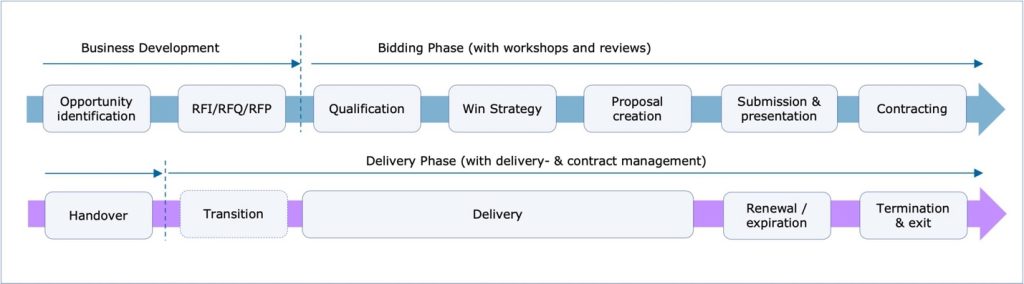
Numerous companies have started integrating AI into their operations, also within the sales process — and that’s my particular focus here. I mean the typical medium- to long-term sales cycles common in B2B enterprises: from Business Development and Bidding through to Contracting and Delivery, a growing number of tools now promise to assist that process and cut down on manual work.
Rapidly evolving tools
Like many of you, I’ve spent time exploring what’s out there — which tools would actually be worth adopting, and what criteria matter most in choosing between them. What I’ve found: an abundance of tools, of wildly varying quality, and a market moving fast enough that any comparison is out of date within months.
The more interesting questions aren’t really about features. Such as: should a tool help identify red flags and risks in an RFP, or focus on qualifying opportunities? Should it draft responses using a client’s own content — and if so, how deep does that integration need to go before you’d trust it with technical, industry-specific material? Is broad sales-cycle support, with room to expand as your team gains experience, more valuable than doing one thing well? And underneath all of it: will the vendor still be around in three years, so you’re not migrating everything again?
I don’t have a universal answer — I’m not sure anyone does yet. But exploring this landscape myself, has been worthwhile. I’m quite often impressed with what AI can already do.
Where it actually changes my work
Here’s what I’ve found more interesting than features of any individual tool. The place AI has had the most impact in my own practice is the situation-analysis phase that comes at the beginning of every commercial engagement and sometimes even before I decide to participate in a client’s sales process. At the start of every commercial situation, I get myself acquainted with a client’s market, market trends, typical customer pains, strategic intentions, competitive environment, current state of affairs. That’s traditionally meant months of reading annual reports, analyst notes, CxO speeches, company collateral, stock price history.
That part of my work — the part I’ve always spent considerable time on — has changed dramatically with AI tooling. I’m getting to far better understanding, and much faster.
That raises the question I actually care about: do better insights lead to better decisions? Does a faster, deeper situation analysis make me a better advisor — or just a faster one? Does it translate into better deal qualification, or a sharper strategy for my client?
I’m about to find out
Over the coming months I’ll be using AI on real cases: an in-depth look at different companies, built entirely from public sources — annual reports, market analyses, competitive positioning — the way I’d normally prepare before engaging or advising a client on a live situation. I’ll be publishing what that process turns up, and what it does and doesn’t tell you that the old way didn’t. Consider this post the first in a short series on what AI-assisted situation analysis is actually worth to commercial advisory work — not in theory, but tested against real companies.